1 Liddell St, North Shields, NE30 1HE
SMaRC, the Swedish Maritime Robotics Centre, has integrated the Succorfish Delphis acoustic modem across its fleet of autonomous marine robotics platforms, creating communication links between surface and subsea systems that are opening up new possibilities for a coordinated network of autonomous operations at sea.
The Delphis is developed by Succorfish in collaboration with Newcastle University, combining world-class academic expertise in underwater acoustics with practical engineering experience to deliver a proven solution for the most demanding subsea environments.
SMaRC, the Swedish Maritime Robotics Centre, is a national cross-disciplinary industrial research centre hosted at KTH Royal Institute of Technology in Stockholm. Askö is a field station for SMaRC in the Stockholm archipelago, one of Europe’s leading marine robotics research environments. Set up to develop the next generation of marine robotics, SMaRC brings together academia and industry to advance four core research disciplines: autonomy, endurance, perception, and communication. Its work spans ocean production, environmental monitoring, and societal safeguarding — with a long-term goal of deploying intelligent, coordinated fleets of maritime robots capable of operating across a range of real-world conditions.
The oceans cover more than 70% of our planet, yet they remain among the least explored and most difficult environments in which to operate. Autonomous marine robotics have the potential to transform our ability to carry out research, monitor the environment, and safeguard society at sea.
But realising that potential requires solving a series of interconnected challenges.
Autonomous surface and underwater vehicles must be able to communicate with each other and with shore-based operators in real time, sharing navigation data, transferring research findings, coordinating the delivery of payloads, and locating and retrieving equipment. These tasks must be completed without human intervention, in extreme sea conditions, and at locations far beyond the reach of conventional support infrastructure.
At the same time, for autonomous marine systems to be deployed at the scale the sector needs, the vehicles themselves must become more affordable. A single expensive AUV limits what is possible. A fleet of cost-effective, capable vehicles, able to communicate, coordinate, and operate autonomously, opens up an entirely new range of applications.
SMaRC exists to prove that this is achievable: that unmanned surface and underwater vehicles can carry out complex, coordinated missions in the harshest real-world conditions, and that the technology is ready to move from research into operational deployment.
Acoustic modems are the enabling innovation making this technology leap possible, providing reliable communication and data transfer underwater where radio waves cannot reach. Connecting sea bed to surface, in a way that previous radiowave technology has never been able to achieve.
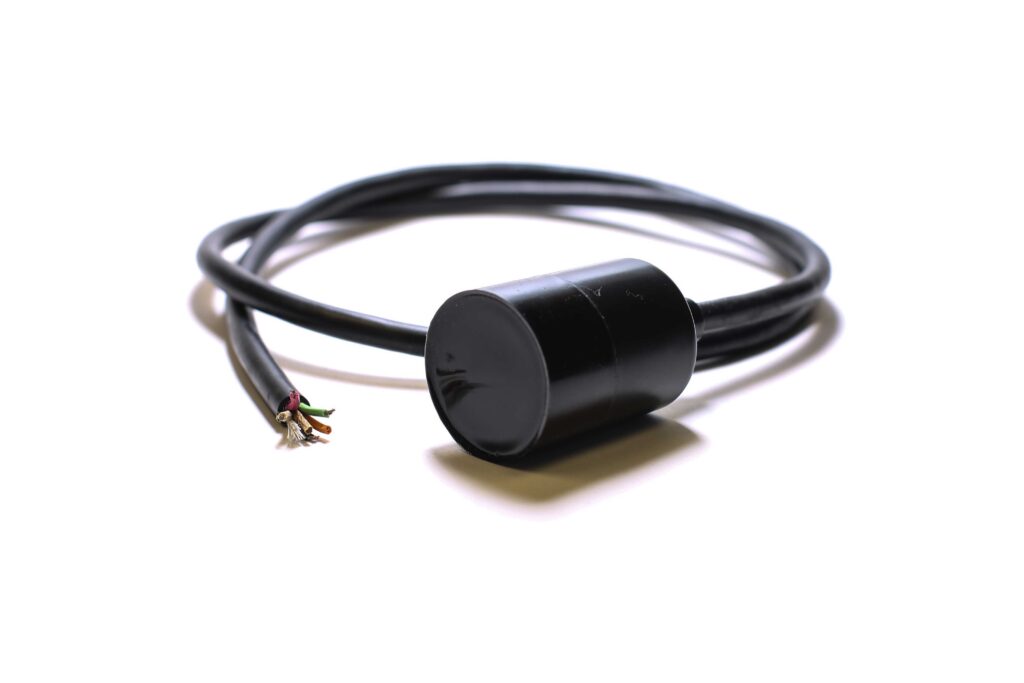
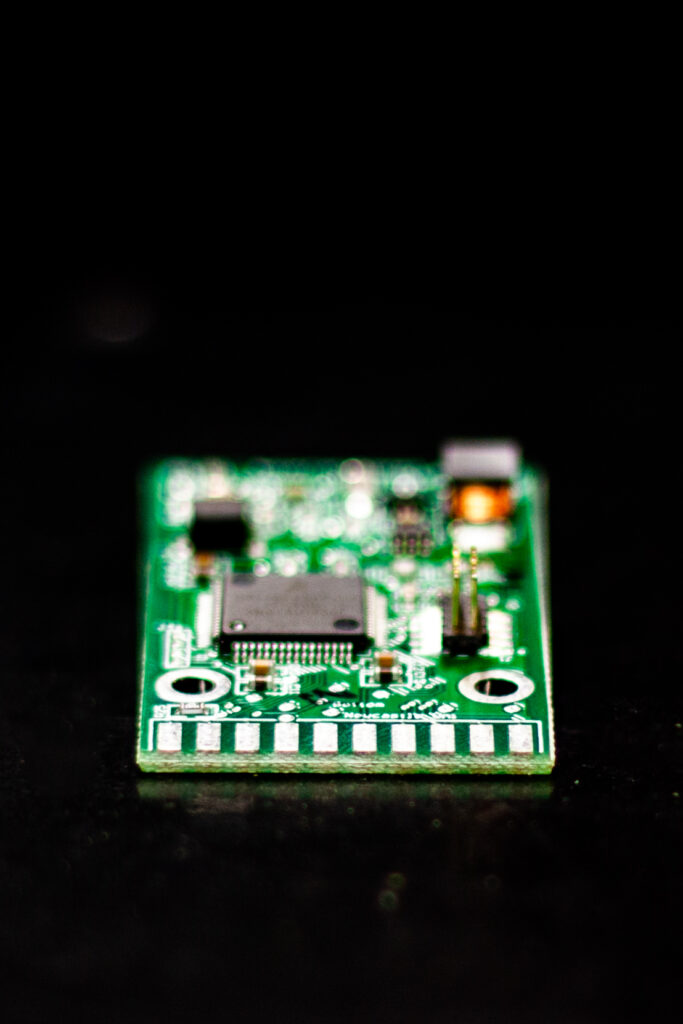
Developed by Succorfish in collaboration with Newcastle University’s School of Electronics, the Delphis acoustic modem provides a practical solution to the challenge of underwater communication.
Instead of relying on radio waves, Delphis uses acoustic signalling to transmit data through water. Short-burst acoustic messages allow underwater assets to exchange information reliably, creating communication links where conventional wireless technologies simply cannot operate — enabling autonomous vehicles to share data, coordinate missions, and remain connected to surface systems in real time.
The Delphis modems deployed across SMaRC’s platforms have demonstrated a range of capabilities that represent a significant step forward in connected autonomous marine operations, including acoustic telemetry, underwater ranging and localisation, one-way travel time acoustic ranging, and the ability to command and control submerged AUVs in real-time field conditions.
At Askö, SMaRC demonstrated the Succorfish Delphis acoustic modem deployed across four autonomous surface and underwater vehicles, each addressing a different dimension of the challenge of connected marine operations.
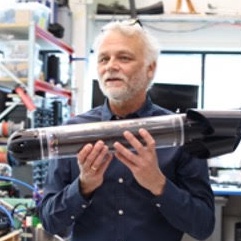
Puffin is SMaRC’s micro AUV, developed under the SP14 Small and Affordable Maritime Robot demonstrator programme at KTH. Torpedo-shaped and weighing under 20kg, it is designed to be deployed and recovered by just one or two people, addressing one of the sector’s persistent barriers to wider AUV adoption: cost and complexity of operation.
It features a thrust-vectoring propulsion system, a variable buoyancy system, and transversal and longitudinal centre of gravity control, giving it the ability to hover, loiter, and manoeuvre precisely in three dimensions.
Equipped with the Succorfish Delphis acoustic modem, Puffin can send and receive data while submerged, be acoustically ranged and commanded from the surface, and operate as part of a coordinated multi-vehicle network, solving the fundamental problem of how a small, affordable underwater robot stays connected and responsive during a mission without the cost and complexity of larger systems.
LoLo (Long-range, Long-endurance) is SMaRC’s flagship large AUV: a mid-size, modular research platform built for extended missions in the most demanding environments, operating at depths to 1,000m, across a full range of salinities, and in polar and ice-infested waters where surfacing to communicate is not always possible.
Its free-flooded hull and three-section architecture, a forward payload bay of approximately 0.4m³, a central energy and buoyancy section, and an aft propulsion and control section, allow the vehicle to be reconfigured for a wide range of scientific missions, from environmental sensing and water sampling to carrying and deploying smaller AUVs as a mothership platform.
From the outset, LoLo was designed to carry acoustic modems as the primary means of underwater communication, connecting it to a wider network of underwater and surface vehicles during submerged operations. The Succorfish Delphis fulfils that design intent, enabling real-time acoustic telemetry, ranging, localisation, and command uplinks that keep LoLo connected throughout a mission.
At the distances and depths LoLo operates, acoustic communication is not an optional capability. It is what makes the mission possible.
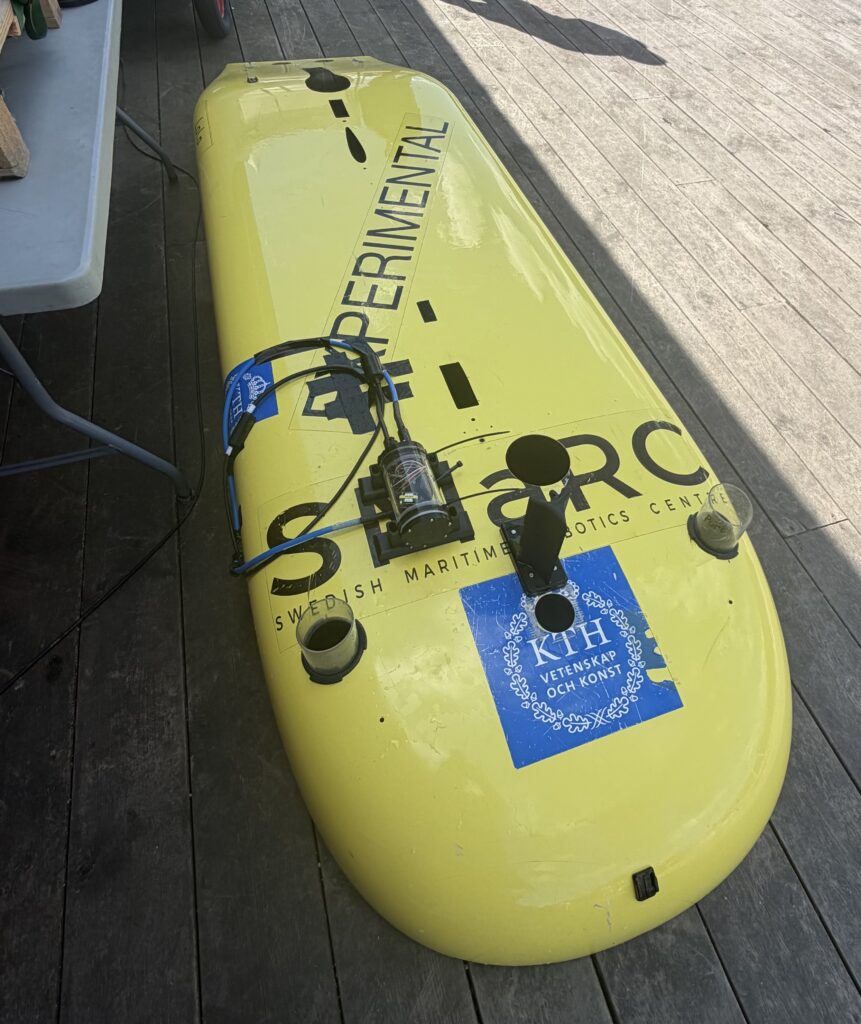
Evolo is an autonomous hydrofoiling unmanned surface vessel developed at KTH by Professor Jakob Kuttenkeuler, the product of more than fifteen years of research into hydrofoiling technology that contributed to foundational concepts behind the modern e-foil industry.
Designed as a flexible research platform with advanced sensors and an autonomous flight controller, Evolo operates on its hull at low speed before the flight controller takes over at take-off speed, autonomously regulating altitude, pitch, and roll to lift the craft clear of the water. It has been tested across a range of conditions from confined flat waters to open-sea high sea states in the Stockholm Archipelago.
At the Askö demo, Evolo was demonstrated carrying a Puffin AUV as a payload, functioning as a high-speed surface delivery platform capable of transporting an AUV rapidly to a remote operational location, overcoming the time and range limitations of conventional vessel-based deployment.
With the Succorfish Delphis mounted on the hydrofoil, Evolo maintains an acoustic communication link to the submerged Puffin throughout the mission, acting as a live gateway between the surface and subsea layers and enabling the kind of coordinated multi-vehicle operations that define the next generation of autonomous marine systems.
A UAV drone can carry a Succorfish Delphis acoustic modem to any point on the water surface, where it is deployed into the water to establish an acoustic link with any submerged assets including AUVs, sensors or equipment.
This makes the acoustic gateway fully mobile and rapidly repositionable, removing the dependency on a surface vessel or fixed buoy to bridge the communications gap between air and sea.
Within SMaRC’s operational ecosystem this capability extends to autonomous AUV recovery, the drone flies to a location, establishes an acoustic link with a submerged vehicle, and enables the tracking and command needed to guide the recovery operation. Where underwater vehicles would otherwise be unreachable, the drone-Delphis combination creates an on-demand acoustic node anywhere it is needed, in minutes.
What makes the collaboration especially exciting is the broader vision it supports.
The future of ocean operations will not be defined by individual autonomous vehicles working alone. Instead, it will be shaped by networks of intelligent systems working together.
Autonomous underwater vehicles wirelessly connected via acoustic modem can share mission status, send and receive data. Sensor networks can transmit environmental observations. Surface vessels can communicate with subsea assets. Multiple systems can begin operating as coordinated teams rather than isolated platforms.
For researchers developing the future of maritime autonomy, the use of acoustic modems for underwater communication represents a significant step forward and transforms a long-standing challenge into an opportunity for innovation. Bringing us one step closer to a truly connected underwater world.
Underwater acoustic communication is essential to advances being made at the cutting edge of autonomous marine robotics. Any organisation developing or operating autonomous underwater vehicles, subsea sensor networks, or multi-platform marine systems needs a reliable solution for subsea communication and data transfer. The Delphis acoustic modem is proven in the most demanding real-world conditions across a wide range of applications, from offshore energy operators communicating with subsea inspection vehicles, to environmental monitoring programmes deploying networked sensor arrays, to marine research institutions pushing the boundaries of what autonomous systems can achieve at sea. The capabilities demonstrated at Askö represent a significant step forward in the development of connected autonomous marine systems.
Succorfish engineers industry leading subsea communication and monitoring technology, and the software to deploy a full solution that connects all your assets underwater with everything above.
Our team are here to help