MyGearTag: The World’s First Commercial Acoustic Fishing Gear Tag

MyGearTag™: From Pan-European Research to the World’s First Commercial Acoustic ALDFG Tag

How Succorfish turned Horizon Europe research into proven technology for locating and recovering lost fishing gear — powered by its proprietary Delphis® acoustic platform.
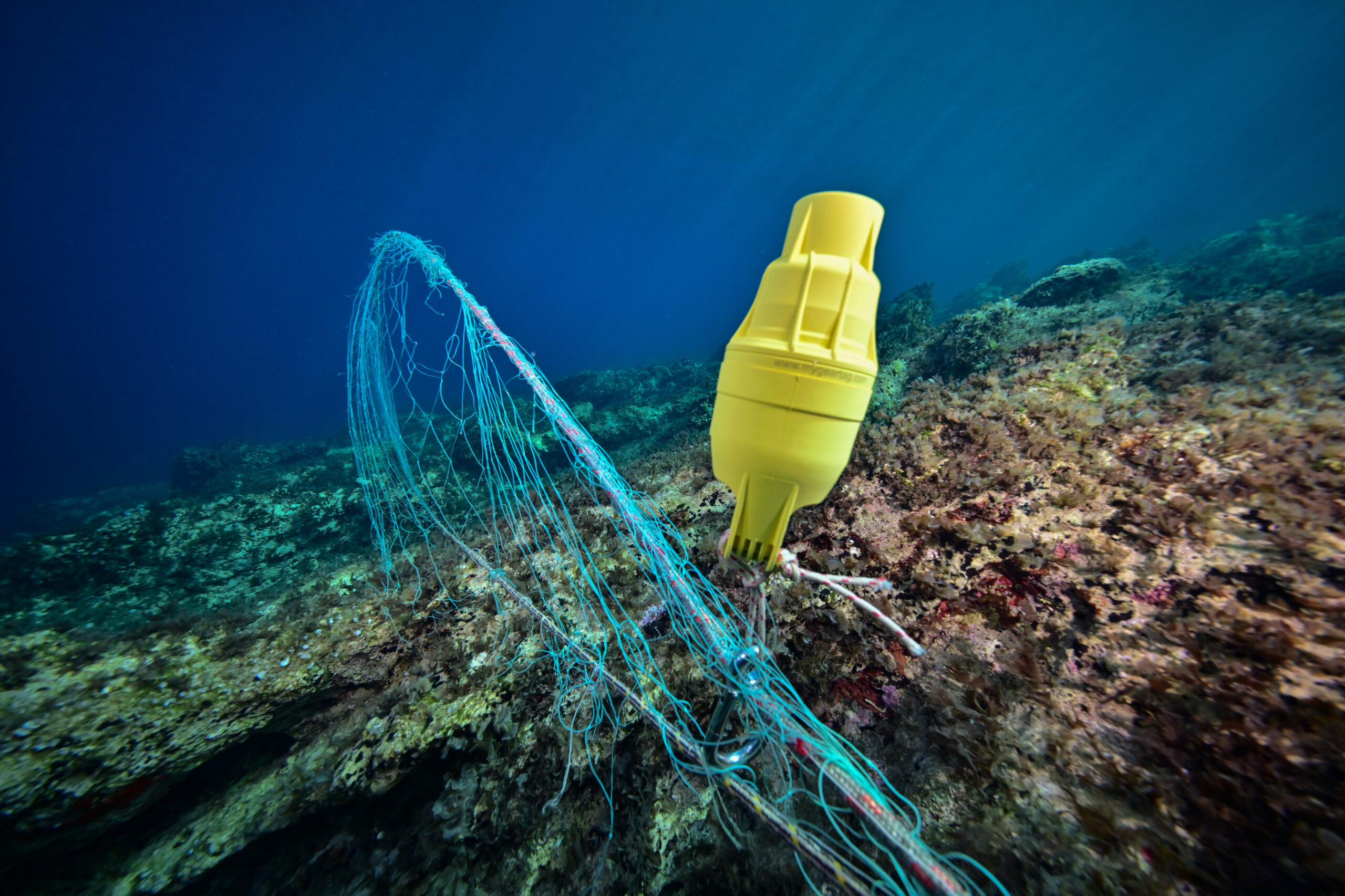
MyGearTag-on-fishing-net

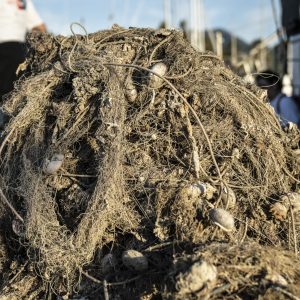
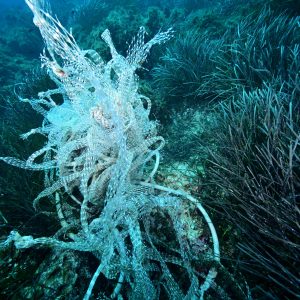
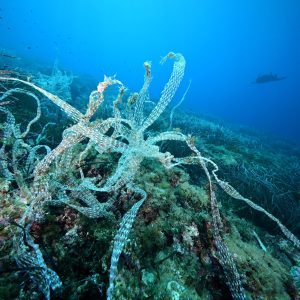
Every year, between 500,000 and one million tonnes of fishing gear is lost at sea. Known as Abandoned, Lost or otherwise Discarded Fishing Gear (ALDFG), or “ghost gear”, this equipment keeps catching fish and entangling marine life long after it is lost, damages sensitive seabed habitats, and is estimated to account for around 10% of all plastic in the ocean. The cost of replacing lost gear alone is put at $2.6 billion a year — and in Europe, marine litter costs the EU fishing fleet approximately €61.7 million annually.

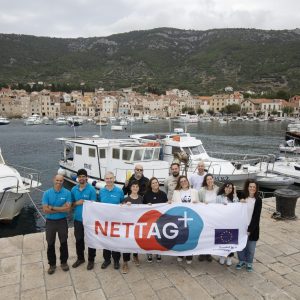
Recognising this challenge, Succorfish joined NETTAG+, a pan-European research and innovation programme funded by the EU’s Horizon Europe, with UK participation supported by UK Research and Innovation (UKRI) through Innovate UK. Working alongside Newcastle University, WWF and partners across seven countries, Succorfish designed, from the ground up, the world’s first acoustic ALDFG tag built for global commercial fisheries: MyGearTag™, powered by Succorfish’s proprietary Delphis® underwater acoustic communications technology.

MyGearTag™ is now a flagship example of collaborative European research being transformed into commercially proven technology — validated at sea, adopted by fishers and conservation groups, and featured on national television.

The NETTAG+ Project

NETTAG+ is a €2.7 million, three-year Horizon Europe project (Grant No. 101112812) contributing to the European Commission Mission “Restore our Ocean and Waters by 2030”. Coordinated by CIIMAR (Portugal), it brings together 15 partners from seven countries: research institutions including Newcastle University, INESC TEC, the University of Santiago de Compostela and the University of Aveiro; environmental NGOs including WWF Mediterranean, WWF Italy and WWF Adria; fisheries organisations and port authorities in Spain, Portugal and Italy; the Maltese fisheries ministry; and technology companies including Succorfish. UK partners Newcastle University and Succorfish are funded by UKRI under the UK’s association to Horizon Europe (Grant No. 10066822).

The project develops three complementary solutions:

  1. PREVENT: empowering fishers as “Guardians and Cleaners of the Ocean”
  2. AVOID: locating fishing gear with acoustic tags — the solution delivered by Succorfish and Newcastle University
  3. MITIGATE: detecting and removing ALDFG already in the ocean.

Crucially, commercial fishers were involved throughout, with solutions co-designed, tested and demonstrated under real conditions in Portugal, Spain, Italy, Croatia, Malta and the United Kingdom.

The Challenge: Abandoned, Lost or otherwise Discarded Fishing Gear

Once fishing gear sinks beneath the surface, GPS and satellite technologies stop working. For decades, finding lost gear meant relying on estimated positions, costly search operations, or simply accepting the loss. Gear can disappear for any number of reasons — bad weather, strong tides, or being accidentally dragged away by another vessel’s gear — and unless its owner knows where it has gone, it can be almost impossible to find again.

The consequences are severe: continuous “ghost fishing” of fish, shellfish and marine mammals; plastic and chemical pollution as gear degrades; damage to seabed habitats; and direct financial loss and reduced efficiency for fishers. The EU reported in 2018 that at least 20% of EU fishing gear is lost or discarded at sea, totalling up to 11,000 tonnes.

Existing underwater tracking systems were built for oil and gas or defence budgets — too expensive, too complex and too power-hungry for everyday fishing operations. Through NETTAG+ workshops and sea trials, fishers, scientists, fisheries managers and conservation organisations consistently defined what was needed: a gear location system that is affordable, easy to deploy, reliable, long-life, effective over long underwater distances, and practical for routine commercial fishing.

The Solution: MyGearTag™ Engineered around Delphis®

Succorfish engineered MyGearTag™ around Delphis®, its proprietary underwater acoustic modem technology, designed from the ground up for long-range, ultra-low-power digital communication underwater. Unlike conventional acoustic “pingers” that transmit continuously, a MyGearTag™ stays silent until actively interrogated — dramatically reducing noise disturbance to the marine environment.

Products used in the MyGearTag system:

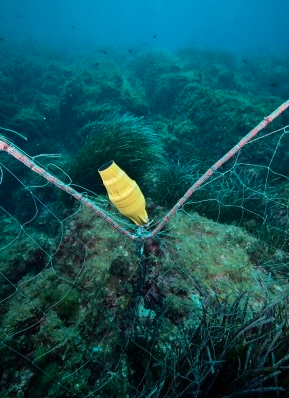
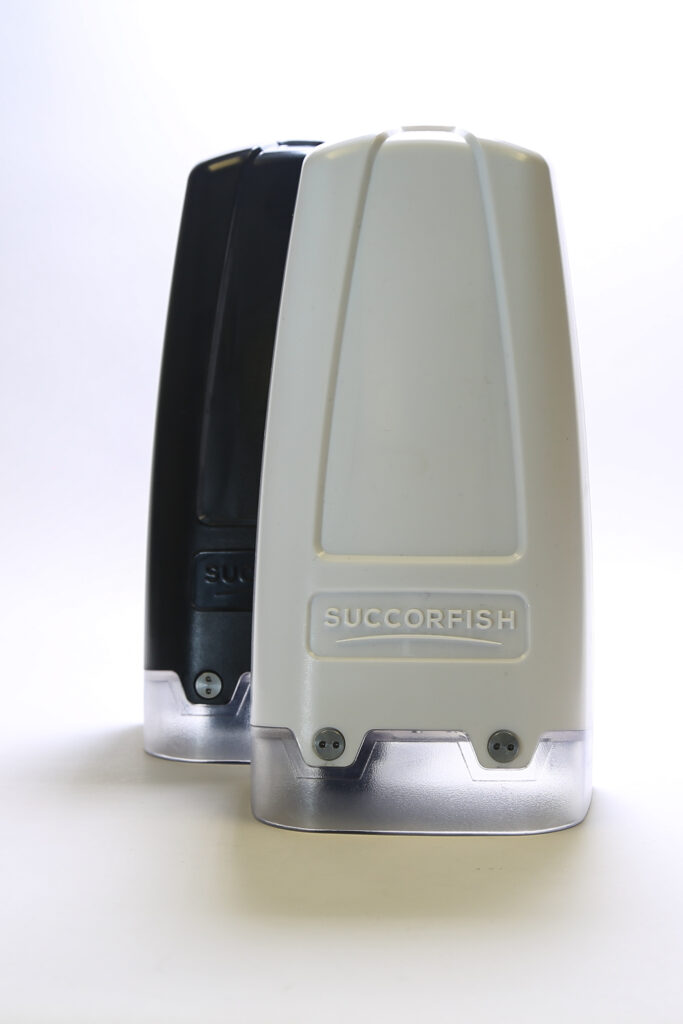
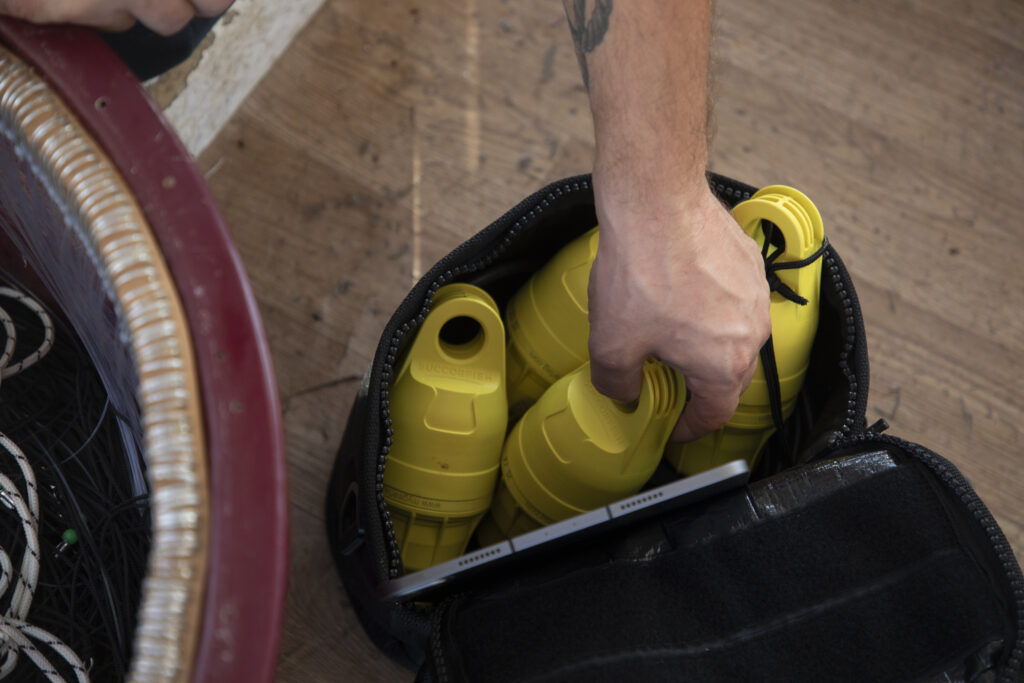
  • MyGearTag™ acoustic tag — attached directly to nets, pots, traps and lines. Housed in a casing made from 100% recycled fishing nets, weighing just 500 grams, and running for more than six months on four AA batteries. Built on the Delphis® acoustic modem.
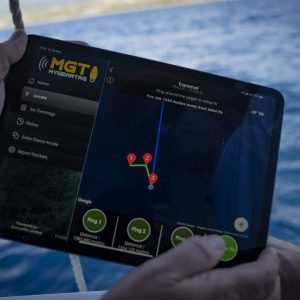
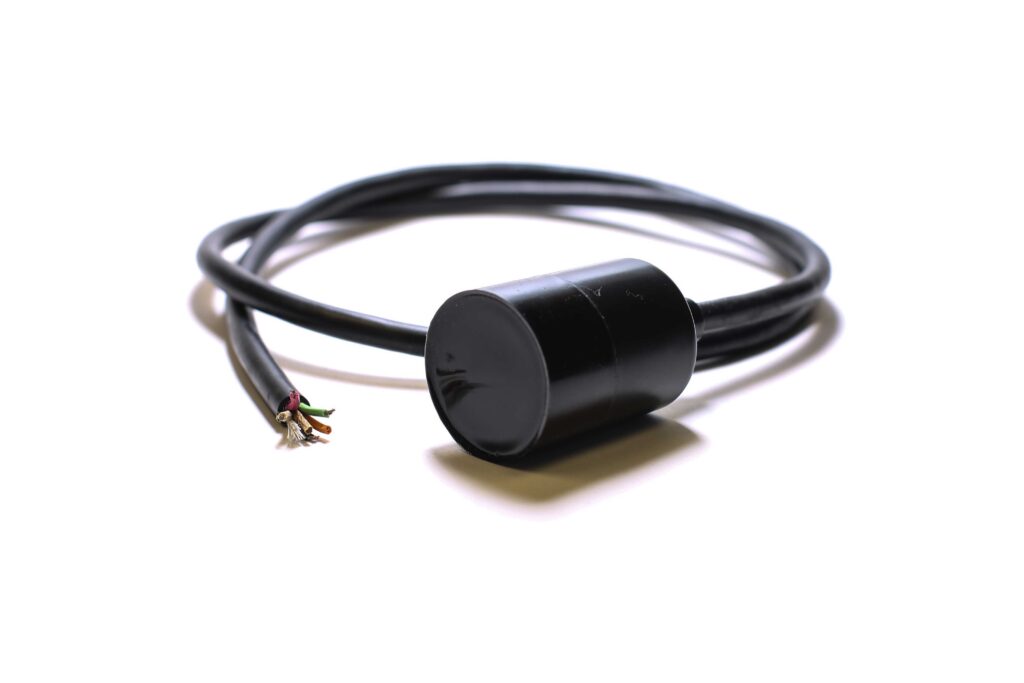
  • Surface Locator Unit — a portable unit deployed from the vessel that interrogates tags and measures range in real time.
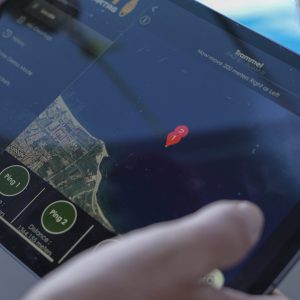
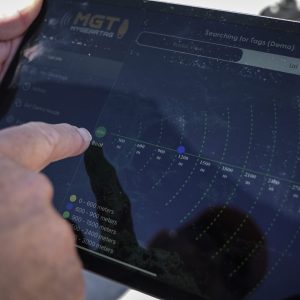
  • MyGearTag mobile app — guides the user through the search, turning range readings into a rapid, targeted recovery operation. Available on iOS and Android.

Key capabilities:

  • Detection range of 2.5–3 km
  • Certified operation at depths beyond 650 m (structurally tested to 1,400 m)
  • Unique user ID for every tag — so only the owner can locate their gear
  • Functionality to share access or switch a tag to public “discovery” mode if gear is deemed irretrievable.

In short: Delphis® is the engine; MyGearTag™ is the complete fisheries solution built around it. MyGearTag™ is the first commercial application of the wider Delphis platform, which also serves defence, offshore energy, scientific research and subsea infrastructure markets.

How the Solution Was Implemented

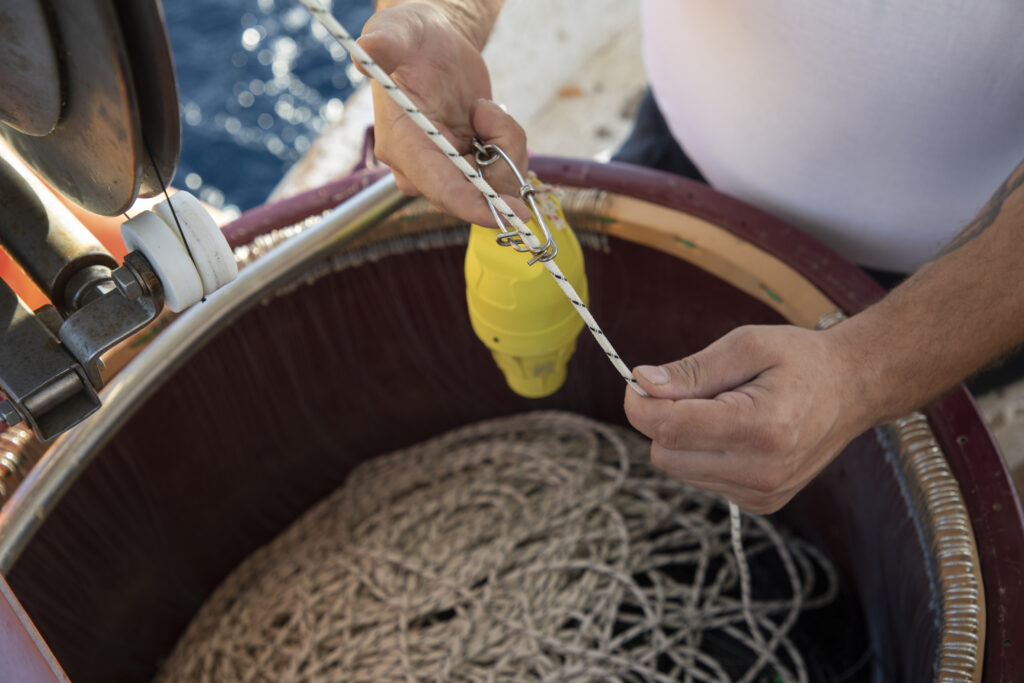
MyGearTags ready for deployment
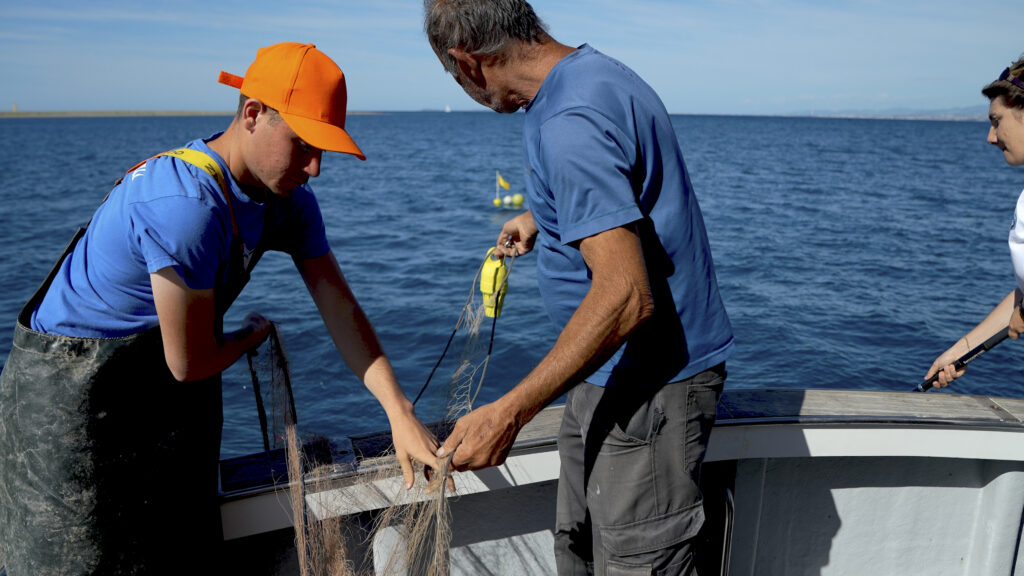
fisherman-attaches-MyGearTag-to-fishing-net

Development followed an intensive cycle of laboratory work, engineering trials and real-world deployments, with hardware and software continuously refined against direct feedback from working fishers across the NETTAG+ demonstration sites in the UK, Portugal, Spain, Italy, Croatia and Malta.

Two milestone trials took place in the North Sea aboard Newcastle University’s research vessel RV Princess Royal. The first was an extensive programme of range testing, confirming detection out to a maximum horizontal range of 2.7 km and proving the system could find lost gear across a wide search area. The second exercised pre-production tags, the Surface Locator Unit and the app in mock recovery operations: two items of simulated lost gear were pinpointed from starting positions over 2 km away in a matter of minutes, allowing the skipper to navigate to within metres of their true position. Further trials followed in the Arabian Sea.

MyGearTag™ was launched commercially at the Scottish Skipper Expo in Aberdeen in May 2024, and within NETTAG+ the system was matured to Technology Readiness Level 9 — fully validated for routine fishing operations, with no specialist expertise required.

The MyGearTag kit confirmed that our equipment was still where it should be, despite having been unable to grapple it after previously sweeping the area. With the precise location plotted, I was able to confidently target the location directly and picked up the lost gear within a couple of minutes of the first sweep.
Neil Armstrong
Master, RV Princess Royal
MyGearTag™ Results

  • The world’s first commercially deployable acoustic ALDFG tag for global commercial fisheries — a successful commercialisation of Horizon Europe research.
  • Technology Readiness Level 9 achieved: validated in real commercial fishing conditions across six countries, with positive feedback from fishers, scientists, NGOs and fisheries authorities.
  • Proven at-sea performance: gear located from over 2 km away in minutes, with recovery navigation accurate to within metres.
  • Following the North Sea and Arabian Sea trials, MyGearTag has been deployed in the North Atlantic, Canada and parts of South America, supporting recovery operations and reducing environmental impact and financial loss.
  • In June 2026, Succorfish donated £10,000 of MyGearTag technology to Clean Planet UK, whose volunteer divers recover ghost gear along 25 miles of North East England coastline between Seaham and Skinningrove.
  • National media recognition: MyGearTag was featured on BBC One’s The One Show — in the same programme that showcased the launch of Sir David Attenborough’s landmark Ocean documentary — introducing acoustic gear recovery to a national audience alongside one of the UK’s most influential marine conservation broadcasts.
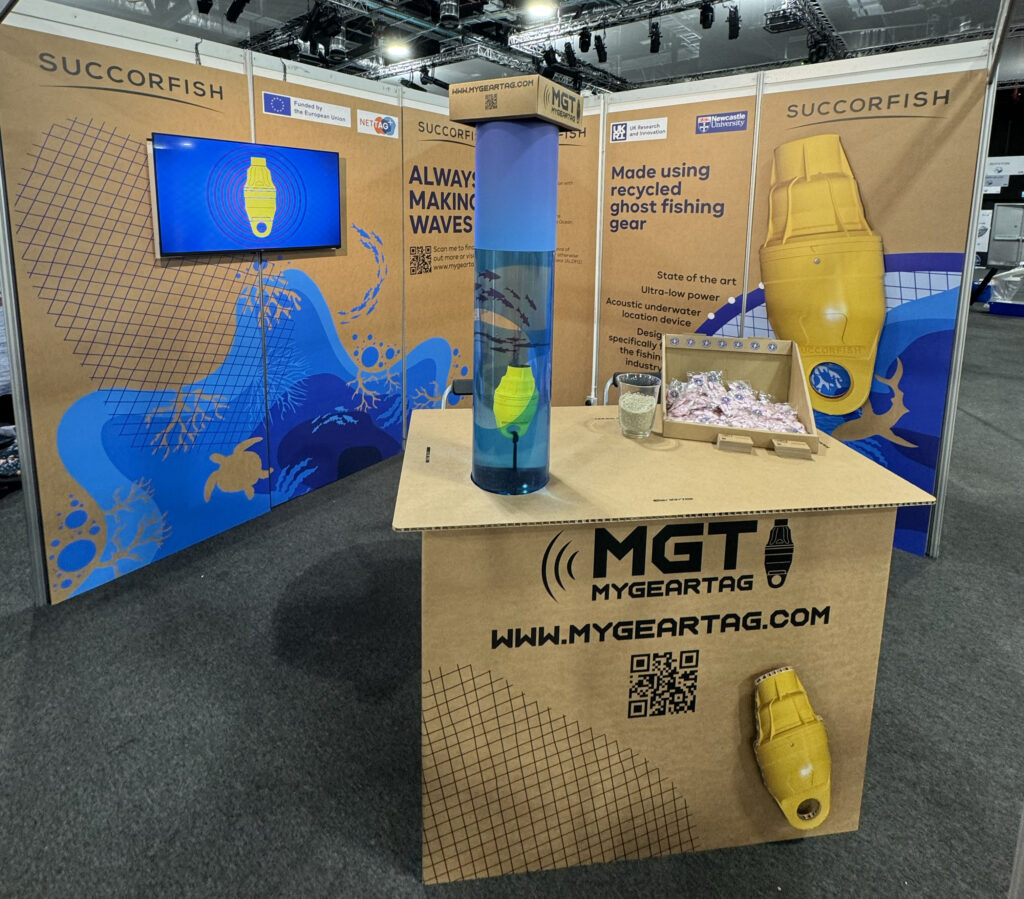
MyGearTag information stand
“Fishing equipment can be lost for any number of reasons, such as bad weather or being accidentally dragged away by other boats’ gear. Unless its owners know where it’s gone, it can be almost impossible to find it again. MyGearTag allows for lost fishing nets, pots, and traps to be quickly located over a wide area, thus avoiding the substantial cost of replacing them and reducing the amount of plastic in our oceans.”
chad-hooper-of Succorfish headshot
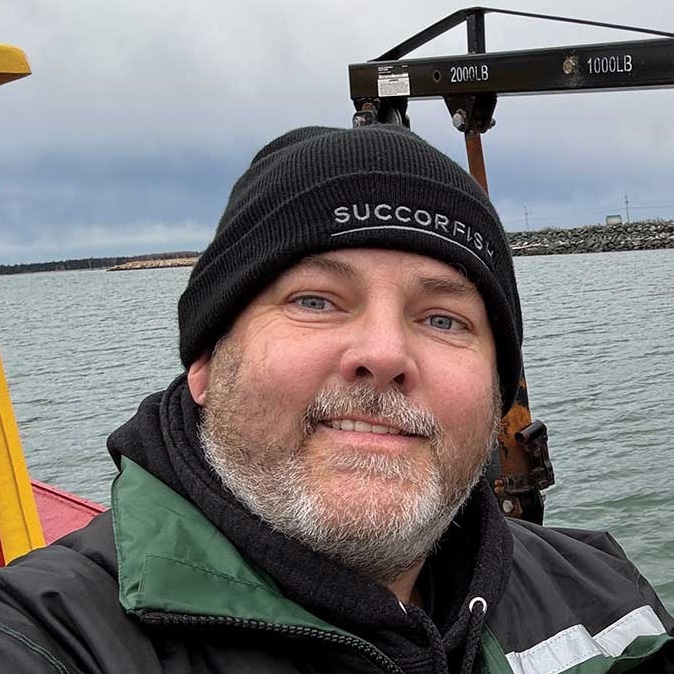
Chad Hooper
Founder & CEO, Succorfish

Wider Impact

MyGearTag™ proves something bigger than gear recovery: that low-cost, low-noise underwater acoustic communication can become foundational technology across the blue economy. Within NETTAG+, MyGearTag tags are also interrogated by IRIS, a robotic subsea recovery vehicle developed by consortium partner INESC TEC, enabling end-to-end location and retrieval even where recovery exceeds the practical limits of a fishing vessel.

The same Delphis platform that powers MyGearTag™ is now being applied across sustainable fisheries, marine conservation, offshore renewable energy, defence and maritime security, scientific research, autonomous underwater vehicles, environmental monitoring and subsea infrastructure. Delphis enables real-time communication and data transfer between divers, underwater vehicles and subsea instruments, and has been demonstrated in action with the Swedish Maritime Robotics Centre (SMaRC) at its Äskö test site — connecting the underwater world well beyond fisheries — supporting Succorfish’s wider Seabed-to-Space™ vision of connected marine monitoring. The SC2 surface gateway is the backbone of this over-the-horizon solution, linking Delphis acoustic devices on the seabed to cellular and satellite networks above the surface — so subsea data can reach any location on earth in real time.

As regulators worldwide sharpen requirements on gear marking, ghost gear and sustainable fisheries, MyGearTag™ gives the industry a practical way to meet those obligations while cutting its own losses.

Who Else Would Benefit?

MyGearTag™ delivers value to any organisation that manages, protects or operates in the marine environment:

  • Commercial fishing fleets and small-scale inshore fishers — avoiding gear replacement costs and lost fishing time.
  • Fisheries management authorities and policymakers — lowering the cost of ghost gear recovery programmes.
  • Marine conservation organisations and charities — marking and relocating ghost gear that cannot be recovered immediately.
  • Offshore renewable energy and oil & gas operators — managing gear loss and asset marking in shared maritime space.
  • Universities and research institutes — affordable recovery of scientific instruments and future integration of environmental sensors.
  • Aquaculture operators — stock monitoring and theft detection.
  • Ports, harbour authorities, search and recovery teams, the diving community and owners of valuable subsea assets.

MyGearTag and the Succorfish Product Family

SC2 tracks vessels and provides connectivity above the surface; MyGearTag™, powered by Delphis, locates gear below it. Together they underpin Succorfish’s Seabed-to-Space™ monitoring vision.

Succorfish’s established satellite and cellular platform, proven as a highly reliable vessel monitoring system across UK inshore fleets. As a surface gateway, SC2 is the backbone of Succorfish’s Seabed-to-Space™ over-the-horizon solution: it bridges underwater acoustic data from Delphis-enabled devices to cellular and satellite networks, delivering subsea data anywhere in the world in real-time.

Succorfish’s proprietary underwater acoustic modem technology, developed with Newcastle University’s School of Electrical and Electronic Engineering: ultra-low-power, short-burst digital communication exchanging data packets between up to 256 uniquely addressable units, with sub-metre “ping” ranging precision, a range of up to 3.5 km and depth rating beyond 350 m. A platform, not a consumer product — already used by research institutes worldwide across oceanography, marine biology and subsea engineering.

MyGearTag is a product brand built on Succorfish Delphis® technology. MyGearTagis the first complete, commercial and fisher-friendly solution for locating fishing gear below the water. It is a complete system including tag, surface locator unit and app – all powered by Succorfish. Visit the MyGearTag™ website for more information.

SUCCORFISH

SEABED TO SPACE
CONNECTED

Succorfish engineers industry leading subsea communication and monitoring technology, and the software to deploy a full solution that connects all your assets underwater with everything above.

Contact us

Download our Apps on the Google Play and App Store

Succorfish App Store Succorfish Google Play